LESSON III
“For we do not know what to pray for as we ought, but the Spirit Itself, intercedes for us with groanings too deep for words.” (Rom. 8:26-27)
“Then to be seeking life, health, strength, peace is to be gnawing after what we already have.” (Esoteric Philosophy, Pg. 17:2)
The life of the Initiate is one, as Oswald Chambers observed, of “giving up our rights to ourselves.” Our ideas give way to the Ideal of Christ, our thoughts give way to Immortal Mind command, and not least of all, our words give way to The Word which is the very breath of Truth. Prayer always works, but to the degree that we can step out of the way, retire our words to The Word we, as well as those we serve, can experience the full flow of God’s Will through us as the revealed Christ.
When we specify, identify, and name in our prayers, not only do we restrict and shape the “river of living waters” that Jesus promised, but we partake in that “gnawing caterpillar” activity that is fraught with survival strategies, duality, fear, and the illusion that we can seek that which we already own by Divine Birthright. As Emma so elegantly states, “both affirmation and feeding are wholly ungodly.” Prayers spoken by “our word” consciousness are an attempt to create God in our own image instead of standing still at every level of our being so that we can be restored to our Original Mind state.
Prayer spoken from “our word” contains a subtle and thinly concealed material aspect to the way in which we pray. Our Being can become lost in our doing and we participate in “means to an end” spirituality that is characterized by a subconscious human idea that we need to tell God what to do. When we develop the surrender, the confidence, the knowing, and the wisdom of Jesus Christ, the individualized Christ as us can offer a prayer that truly activates Cause by saying, “Your Father knows what things you ye have need of before you even ask.” (Matt. 6:8)
When we specify in prayer, we identify. When we identify in this way, we unwittingly grant the illusion of reality to those concepts, conditions, and ideas that have none and never did. Identification also opens the possibility of identifying WITH something and the illusion of its opposite. “But thou, when thou prayest, enter into thy closet, and when thou hast shut thy door, pray to thy Father which is in secret.” (Matt. 6:6). In the deeper, esoteric sense, this passage instructs us, as it did the Disciples, to pray with our senses as well as our sensibilities removed from the world so that the clarity of Christ may guide our words to The Word.
So it seems that the path of the Initiate reaches a crossroads in prayer life, as in many other arenas, where vital questions are asked and answered. Am I praying in fact or in Truth? Do I pray in the illusion that something is missing or in the confidence and conviction that nothing ever is? Does my prayer reflect my words (conditions) or The Word (Cause)?
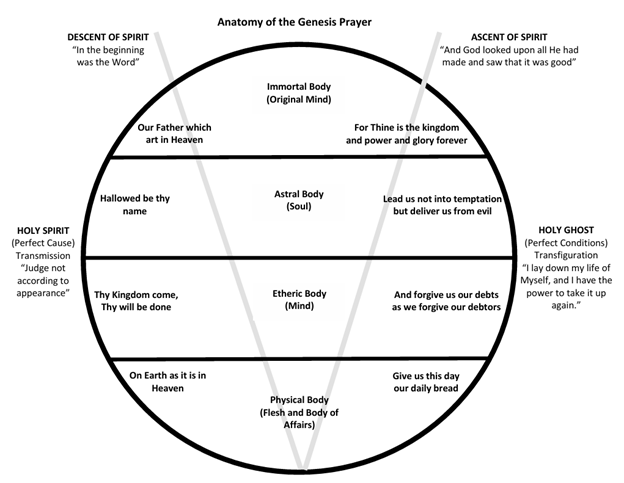
Praying from Pure Cause, free of agenda, specification, and identification brings forth the Genesis Prayer in and through us. This is the prayer that declares Being is more exalted, more elegant, and more powerful than any which “requires something to happen.” Such prayer steeps itself in purity, perfection, and Truth, freeing us and those we serve from the attachment and hypnosis of time and matter. As we purify and perfect our word, The Word stands forth and every condition becomes purified and perfected as well. Every miracle performed by Jesus Christ came forth from this purified and perfected process.
Praying as Lord Jesus did reunites us with, as Emma calls it, “the Original Me, the Eternal I Substance which is by Itself, not identified with anything yet the Eternal Cause of all.” Imagine gathering around the campfire light with the Disciples one starry night when Jesus is asked by one of them “Lord, how should we pray?” (Lk. 11:1) The answer came in the form of the greatest prayer ever spoken and the model for us all: The Lord’s Prayer.
The Lord’s Prayer is the prayer spoken from the Genesis Mind as Christ. The Genesis Mind lifts prayer out of the relative and into the Absolute, out of the mental and into the Mystical. As we look toward the Christ command to “judge not according to appearances.” (Jn. 7:24) The mystery of the Lord’s Prayer is realized as we endeavor to pray not by appearances as well.